Sunday, February 17, 2013

Free book!

I've decided to serialize my book to make it more readily available to people. Of course, if you don't want to wait for the next installment, you can always by the book (paper or eBook) on Amazon.com!


Introduction

Anyone who is not shocked by quantum theory
has not understood it.—Physicist Niels Bohr
I’m not really qualified to write this book. Heck, I’m barely qualified to read it. But that’s part of why I wrote it in the first place. There are more than a few books on science and theology, but they tend to be weighty volumes meant to impress scholars, not to help ordinary people resolve the tensions between their scientific and religious beliefs. Most books that relate modern physics to religion do so by talking about Eastern religions like Buddhism. As far as I know, there’s no book that takes both physics and Christianity seriously, and that does so in a way that people like you and me can understand.
And so that’s why I had to write this book, because no one else had written it, and I wasn’t sure that anyone would. Besides, I thought that I had at least a little something to contribute along these lines. I have a Master of Divinity degree from a reputable seminary (which I won’t name so they can stay reputable) and spent almost three years as a Presbyterian minister. Then I became a technical writer for a well-known computer company (ditto). To make sure that my nerdiness was not limited to hardware and software, I continued to exercise my biblical aptitude by teaching Sunday school and tried to keep my lunchtime reading list as broad as possible.
That’s what led me to The Physics of Consciousness by Evan Harris Walker. This book, a compelling mixture of quantum mechanical theory, Zen Buddhism, and personal reminiscences, started me on the path of questioning both my understanding of what science tells us about the world and what traditional Christianity tells us about God. I learned that the universe is not a precisely engineered machine, but a roiling cauldron of innumerable random and sometimes weird events. I also realized that the common image of God as an old, bearded man surfing the clouds, even when abstracted to something along the lines of a Great Spirit motif, couldn’t really mesh with the picture of reality painted by quantum theory.
That led me to further reading on the subject, and the Reading List at the end of the book tells you about the books I found most useful. The one thing that struck me about most of those books, though, is how dauntingly opaque they are. A few of them had so much advanced theory (for me, at least) that I had to skip over whole sections just to keep my head from exploding. And even though many of them looked at the religious repercussions of quantum theory, they did so in the context of Eastern religions that talk about a world that is, at its core, just an illusion. It’s a lot more difficult to talk about Christian faith in the context of a description of reality that doesn’t fit the notion of a creator spinning the universe into being like a potter working clay on his wheel. So I decided to accept the challenge of writing a book that tries to do so, even if I’m not the best qualified person for the job. If that person would kindly step forward, I’ll be more than happy to hand over the responsibility to them.
Then again, even though I’m undoubtedly not the best qualified, perhaps I’m qualified enough. While I lack the certifiable scientific and theological chops that would make this book both informative and credible, I at least have 20-some-odd years’ experience as a professional communicator that has taught me the importance of writing to my audience, a skill that most scholars notoriously lack. So possibly I understand the subject matter just well enough to interpret it for readers who have just a little less understanding but are seeking to gain more.
So, Gentle Reader, the book you hold in your hand isn’t intended to overwhelm your skepticism with footnotes and formulas, much less to use them as a device to prove the existence of God or the fundamental truth of the Christian faith. Rather, it’s my hope to give you a taste of the frankly bizarre universe portrayed by quantum physics and to show how the very nature of that bizarre universe actually leaves room for God’s existence and activity in a way that classical science could not. Finally, I want to take a fresh look at the Christian faith in light of those insights and consider which traditional beliefs can be sustained and which must be radically redrawn.
In the end, I pray that you will approach this book with an open mind. If you do, even if it doesn’t change your opinions, at least it will give you the opportunity to better understand your beliefs and how they are being challenged by the a scientific worldview you probably didn’t learn much about in school. That’s really all that I ask of this book, and I hope you will, too.
I’d like to add a brief note about the language I used to refer to God. Although my time in seminary and other corners of Christianity has made me sensitive to the problems that come from using masculine language (he, his, him) to refer to God, and even though I really don’t believe God is somehow more male than female, I deliberately chose to use masculine language to talk about God. I did so because, frankly, I didn’t want my refusal to use traditional language to become a stumbling block for those of you who haven’t yet adapted to a more gender-neutral view of God. Even more important, as I talked about God in the light of quantum physics, I found that the portrayal of God sometimes became so abstract that it began to verge on turning a personal God into a thing. That wasn’t my intention, so I continued to use personal pronouns (which, in English, are unavoidably gender specific) to struggle against that tendency. To those who are put off by the results of that decision, I apologize.

Monday, April 23, 2012

Tonight I was forced to take a break from work, so I decided to make use of my unexpected free time to create a Facebook page for my book. (http://www.facebook.com/quantumchristianity). I'm hoping that this will help draw me into contributing to it and this blog regularly instead of rarely and that the addition of social media to the mix will make it easier for us to keep in touch.

Mundane miracles


Today in the Adult Christian Education class I was teaching, we were talking about miracles wrought by Jesus as recorded in the Gospel of Mark. One of the sticking points was whether an event had to be unexplained in order to qualify as a miracle. My response to that question was that requiring a miracle to have no explanation is that ends up turning God into the "cause of last resort," the God of the gaps who exists only in the gaps of our understanding.

To me, a miracle is an event that may or may not be able to be explained in scientific or other terms, but that has meaning to me as a sign of God's presence and activity in my life. I can explain fairly readily how my children were conceived, gestated, and born (despite the lack of sex education in the schools I attended). But it's still a miracle to me that God gave me such wonderful, loving, kindhearted, and downright adorable kids who enrich my life in so many ways. The fact that I can describe the mechanisms by which that took place only adds to the sense of awe that I have when I contemplate these miracles in my life.

According to the Copenhagen interpretation of quantum phenomena, the observer plays a crucial role in the unfolding of an event. For me, the same is true of the events in my life: I observe the events around me as miracles, not just random events with no meaning. A miracle is a miracle because I say it is, because I see God at work in every event, no matter how miniscule, no mater how common.

Friday, December 2, 2011

Quantum entanglement and apophasis

Last month my wife (Patty), our son (Jeremy), and I flew down to San Francisco for the Annual Meetings of the Society of Biblical Literature and the American Academy of Religion. While our primary purpose for being there was to be a cheering section for our daughter, Christy Riley, who presented a paper at an SBL session, it  also gave Patty and me an opportunity to indulge in a couple days of nostalgia. That's because 34 years ago, as employees of Scholars Press (a joint venture of the AAR and SBL and others), we helped organize and run the same meetings in the same city. (My main job was to make sure the requested AV equipment was set up, which back then meant overhead and slide projectors.)

Besides Christy's session, I was also able to sit in on a presentation called "The Entangled Universe: Physical Explications, Theological Complications" by Dr. Catherine Keller, who just happens to be a teacher at Drew University, where Christy is earning her Ph.D.  

While Dr. Keller's AAR presentation was suitably dense for a scholarly audience, fortunately for the rest of us, she shared many of the same ideas in an interview with Beatrice Marovich for Religion Dispatches magazine.

R.E. Slater, in his Relevancy22 blog, reproduces the RD article and adds some useful contextual material, including a discussion of apophatic vs. cataphatic theology. That's a distinction I wish I'd been more mindful of as I was writing Quantum Christianity, to be honest. Maybe I'll have to produce that second edition sooner than I'd hoped.

Wednesday, November 9, 2011

It's published!


Quantum Christianity is now available for purchase from Amazon, both in paperback and for the Kindle.

To get a peek, go to amazon.com.

Sunday, September 4, 2011

What the heck is Quantum Christianity?

When most people think of the contention between science and religion, it's usually in terms of the argument over biological evolution. Somehow the apparent contradiction between Darwin's theories and a handful of verses in the book of Genesis is generally accepted as the core of this debate, when it's really just a side show, a side effect of the real conflict that is at the root of the seeming chasm between the scientific and the religious world views.

The truth is, the battle between science and religion is not between Darwin and God, but between Newton and God. After all, it was Newton who was the first to assert that, theoretically at least, the entire universe could be described by a set of mathematical equations and who took the first steps toward doing so. The result was Newton's famous laws of thermodynamics, the palette that subsequent physicists have used to paint a portrait of the universe that not only does not require a God as its creator and sustainer, but even excludes the possibility of a God who is able to intervene in its processes. For Newton and his scientific descendants, the universe is merely a perpetual motion machine that is not just independent of any divine intervention, but would cease to function if God were actually to interfere in its affairs.

This would be just yet another clash of world views, not substantially different from that between, say, Buddhism and Judaism, were it not for one disturbing (for believers, at least) fact: Science, especially physical science (its most distilled form), has proven to be the most reliable means of predicting and controlling future events and for explaining past events. What used to be the principal function of prophets and seers has been taken over by nerds in lab coats.

What most people don't realize, though, is that the primacy of Newtonian physics (and mathematics) as the fundamental way of describing the roots of reality began to be overturned over a century ago. This revolution was the result of the appearance of a new way of understanding matter and energy. This method came to be known as quantum physics because it studied how energy can be viewed as being contained in distinct chunks, called quanta. As physicists drilled deeper into this theoretical framework, they found a lot of strange things (dubbed "quantum weirdness") that not only displaced the mechanistic world view of Newton but even suggested that there might even be a place for God—or something that at least resembles God—in the quantum universe.

So that's what this blog is about, the possibility that the world view based on quantum mechanics might somehow be compatible with a (note I didn't say "the") Christian world view. I'll be posting some material I've been developing for a book on the subject as well as reacting to current events and any comments that readers post in response to my thoughts and others'. Later I'll add more information about myself and why I think I might be qualified to expound on such things (which I'm not, really) and maybe any ground rules for the discussion if things seem to be getting out of hand.

About Me

My photo
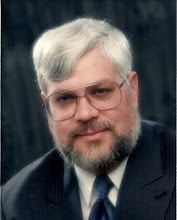
I am a former Presbyterian minister (and hence a holder of a Master of Divinity degree) and presently a technical writer for a Very Large Software Company (yes, you guessed right). My academic background is in things religious, but I have just enough interest in things scientific to support the delusion that I can write about them. In other words, I am a veritable salt shaker of dubious propositions.

Followers